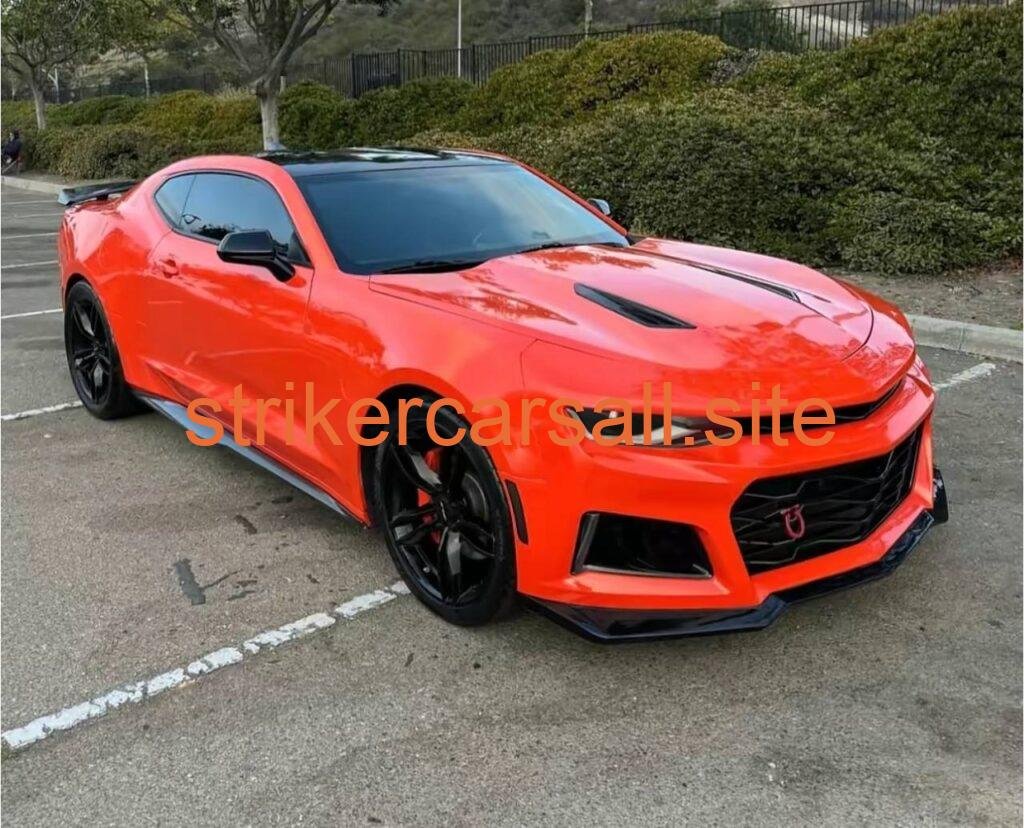
Cheap Camaro for sale is one of the most satisfying searches in the car world, because the Camaro delivers more horsepower per dollar than almost anything else on four wheels.
Right now we have a 2023 Camaro SS at $3,000. A 2016 Camaro 2SS at $3,000. A 2018 Camaro ZL1 1LE at $3,500. A 2021 Camaro ZL1 at $5,500. Fourteen Camaros in total, every one a no-title striker car with an intact, checkable VIN.
For context, a new Camaro SS starts around $45,000 and a ZL1 clears $75,000. Even used, they hold real money on the open market. Ours start at $2,800.
The Camaro is also a car with a proper story behind it — the answer to the Mustang, the archetypal American pony car, and a machine that’s been in and out of production five times over six decades. The current generation ends in 2024, which makes every one of these a modern classic.
Let’s go through it all properly. Why they’re cheap, whether they’re any good, what the trims actually mean, every single car we’ve got, and what it really costs to run one.
Why Are These Camaros So Cheap?
Three structural reasons, none of which involve the car being a wreck.
Depreciation already happened. Muscle cars lose value like anything else. A Camaro SS that cost $45,000 new is worth a fraction of that after a few years, and the first owner ate the hit. You’re buying after the fall.
The striker model strips the layers. Our cars are sold without a title, sourced from the US via insurance write-offs, salvage auctions, fleet disposals and export channels. No dealer margin, no financing, no state title transfer up front, no warranty. Every one of those layers normally sits inside the price. Remove them, and the number drops hard.
The buyer pool is smaller. “No title” spooks most people. Dealers won’t touch these cars, banks won’t finance them, and private buyers assume the worst. Less demand, lower prices. If you understand the process, you profit from everyone else’s hesitation.
Together, that produces pricing 30–50% below the already-depreciated market. On a Camaro, that’s the difference between a $25,000 used car and a $3,000 one.
Full explanation in our striker car price page. Terminology in striker car meaning and what are striker cars.
Why the Camaro Matters
Worth a moment on what you’d actually be buying, because the Camaro is more than a fast coupe.
The Camaro launched in 1966 as Chevrolet’s direct answer to the Ford Mustang. It kicked off the pony car wars, went through five generations, disappeared entirely between 2002 and 2010, and came back on a new platform to enormous success. It’s been a cultural object as much as a car — in films, in songs, on bedroom walls.
The current generation is genuinely good, too. It’s built on GM’s Alpha platform, shared with the Cadillac ATS, which means independent rear suspension and a chassis that actually handles rather than just going fast in a straight line. The SS and ZL1 are proper performance cars, not just straight-line bruisers.
And it’s ending. Production stops after 2024, which means every Camaro on the road is now a last-of-line car. That tends to firm up values over time.
If you want American muscle with genuine handling, this is it. And at these prices, it’s absurd.
Camaro Trim Levels, Explained
Before the inventory, understand what you’d be buying. The Camaro range spans a wide gap from sensible to savage.
LS / LT — the entry models. Turbo four-cylinder or V6. Quick enough, economical, the daily-driver Camaros.
RS — an appearance and equipment package, usually on the V6. Sportier looks, bigger wheels, sharper styling.
SS — the V8. 6.2-litre LT1 engine, around 455hp. This is the real muscle car, and it’s the sweet spot of the range for most buyers.
LT1 — a newer trim that puts the V8 into a more affordable package. Less equipment than an SS, same engine. Serious value.
ZL1 — the supercharged monster. 6.2-litre supercharged V8, 650hp, uprated chassis, brakes and cooling. A genuine track-capable weapon.
ZL1 1LE — the ZL1 with the extreme track package. Aggressive aero, hardcore suspension, and one of the fastest track cars GM has ever built.
So: LT and RS for daily driving, SS and LT1 for V8 muscle, ZL1 and ZL1 1LE for genuine supercar pace.
Every Camaro We Have in Stock
Here’s the full list. Fourteen cars, every one with a checkable VIN.
The ZL1s — Supercharged Monsters
The ZL1 is the Camaro at its most extreme, and we’ve got a remarkable number of them.
The 2018 Camaro ZL1 1LE is $3,500 with 39,000 miles. The 1LE is the track package — this is one of the most capable track cars GM has ever built, and at $3,500 it’s genuinely ridiculous.
The 2013 Chevrolet Camaro ZL1 Coupe is $3,500 with 39,000 miles.
The 2023 Chevrolet Camaro ZL1 is $5,000 with 17,000 miles.
The 2023 Chevrolet Camaro ZL1 Coupe 2D is $5,000 with 31,000 miles.
The 2021 Camaro ZL1 is $5,500 with 26,000 miles.
Plus two more ZL1s listed as 2022 ZL1 and 2022 ZL1, both at $5,000.
That’s seven ZL1s. Seven. Most dealers would kill for that.
The SS and LT1 — The V8 Sweet Spot
If the ZL1 is too much, the SS and LT1 give you the 6.2 V8 without the supercharger — and they’re the best value in the range.
The 2023 Camaro SS is $3,000 with 27,000 miles. The 2023 Camaro SS is $5,500.
The 2016 Camaro 2SS is $3,000 with 27,000 miles.
The 2018 Camaro LT1 is $4,000 with 24,000 miles. And there’s a 2022 Chevrolet Camaro LT1 Coupe at $5,000.
The RS and Entry Models
The 2022 Camaro RS is $5,000 with 21,000 miles.
And the cheapest of all: the Chevy Camaro Striker car at $2,800.
Also Worth Knowing
Chevrolet as a brand has more on offer — see Chevrolet cars for sale and the wider full inventory.
Which Camaro Should You Actually Buy?
Straight guidance, because fourteen options is a lot.
Best value full stop: the 2018 Camaro ZL1 1LE at $3,500. A 650hp supercharged track weapon for the price of a used hatchback.
Best daily driver: the 2023 Camaro SS at $3,000. V8, modern, 27,000 miles, and cheap.
Best V8 value: the 2018 Camaro LT1 at $4,000. V8 engine, lower equipment, less money.
Cheapest entry: the Chevy Camaro Striker car at $2,800.
Best all-rounder: the 2016 Camaro 2SS at $3,000. Well-equipped V8, sensible money.
Lowest mileage ZL1: the 2023 Chevrolet Camaro ZL1 at $5,000 with 17,000 miles.
What These Cars Are Actually Like to Own
Let me be specific rather than vague.
Driving a Camaro SS
The 6.2-litre V8 makes around 455hp and sounds exactly like an American V8 should — deep, hard, and loud when you want it. The Alpha platform means it handles properly, with real steering feel and a chassis that stays composed. The manual option (where fitted) is genuinely good.
The downside is visibility. The Camaro’s high beltline and thick pillars make it feel like a bunker, and over-the-shoulder visibility is poor. You get used to it, but it’s a real characteristic.
The rear seats are small. The boot is usable. It’s a two-plus-two coupe, not a family car.
Driving a ZL1
Take the SS and add a supercharger, uprated brakes, revised suspension and more cooling. 650hp, a hard-edged supercharger whine layered over the V8 rumble, and performance that embarrasses cars costing ten times as much.
The ZL1 1LE takes it further — aggressive aero, spool-valve dampers, and a ride that’s genuinely firm. It’s a track car that happens to be road legal.
Living With Either
Both are loud, both are conspicuous, both drink fuel. Both are also enormous fun and will make you take the long way home. That’s the trade.
The Honest Bit — Running Costs
This is where people get caught, so let’s be blunt.
A cheap Camaro is still a V8 muscle car to run. The purchase price is low. The costs are not.
Fuel. A 6.2 V8, supercharged or not, drinks heavily. This is the single biggest ongoing cost and it’s unavoidable.
Servicing. GM mechanicals are widely known and parts are common, so servicing is cheaper than a German equivalent. But oil changes are frequent and consumables add up.
Tyres. Big, wide, and on the ZL1, very expensive. The ZL1 will destroy a set quickly if you drive it properly.
Brakes. Standard SS brakes are reasonable. ZL1 brakes, especially with the track package, are serious money.
Insurance. A V8 muscle car costs more to insure than a hatchback. Get a quote first.
Parts. Widely available and reasonably priced, which is a genuine advantage over European rivals.
Budget a maintenance fund. A Camaro is cheaper to run than an M5 or an RS 7, but it’s not a Corolla.
For the wider decision, see are striker cars worth it.
What to Check Before Buying a Cheap Camaro
Do this properly.
- Get the VIN and run it through NICB and INTERPOL
- Decode the VIN via the NHTSA VIN decoder
- Request photos, video and a written condition report
- Ask about service history
- Scan the ECU — see OBD-II scanner reading
- Check for frame damage — see frame damage detection
- Inspect on arrival with your own mechanic
Full process in how to check if a car is stolen and the pre-purchase inspection checklist.
Registration — How It Works
A no-title Camaro registers like any no-title car. The VIN is intact, which is what matters.
In the US, the standard route is a bonded title — appraise, bond, submit, wait, receive title. Many states allow conversion to clean later. The bonded title mechanism is routine and well established.
Elsewhere, you use your country’s equivalent. We help with our side and provide the bill of sale. You confirm local rules.
See register your striker car and car without title for sale.
How Buying Works, Step by Step
- Pick your Camaro. Message us. Ask for photos, video, the VIN.
- Get the details. Condition, mileage, notes.
- Pay the deposit. $1,000 in USDT or Bitcoin — deposit wallets.
- We ship. Export paperwork and freight to your port.
- You inspect on arrival. Bring your own mechanic.
- We register it in your name.
- You pay the balance. Cash on delivery.
Two payments. No finance. No credit check. No interest.
Full detail in how to buy a striker car. Shipping methods in container striker cars. International buyers: international no title cars and export striker cars.
Not Set on a Camaro? The Alternatives
If you want muscle but the Camaro doesn’t fit, here’s the rest.
The direct rival: the 2020 Dodge Challenger SRT Hellcat at $4,500, the 2023 Dodge Challenger at $5,000, or the 2022 Dodge Challenger SRT Super Stock at $3,500. See Dodge cars for sale.
Ford’s answer: the 2025 Ford Mustang GT at $5,000 or the 2024 Ford Mustang Dark Horse at $4,000. See Ford cars for sale.
The other Chevy: the 2023 Chevrolet Corvette Stingray at $6,000, the 24 Vette Z06 Coupe 1LZ at $6,500, or the 2020 Stingray at $6,500.
Four doors instead: the 2021 Dodge Charger SRT Demon at $5,000 or the 2020 Dodge Charger Scat Pack WideBody at $3,500.
JDM alternative: the 2020 Nissan GT-R at $5,000.
German performance: the 2021 Audi RS 7 at $5,000 or the 2019 BMW M5 at $3,500.
Cheap speed on two wheels: the 2021 Honda CBR1000RR-R Fireblade at $2,000.
Wider market at cheap supercars for sale and affordable striker cars.
Cheap Camaro for Sale — FAQ
How cheap is a Camaro here?
From $2,800. Most sit between $3,000 and $5,500.
Why are they so cheap?
Depreciation already happened, and the striker model removes dealer margin, finance and title transfer.
Are these cars stolen?
Usually not. They’re insurance write-offs, salvage auction stock and export inventory. Check the VIN.
Can I register a no-title Camaro?
Yes, via a bonded title or local equivalent.
What’s the difference between SS and ZL1?
The SS has a 455hp naturally aspirated V8. The ZL1 has a 650hp supercharged V8 plus uprated chassis, brakes and cooling.
What’s the ZL1 1LE?
The ZL1 with an extreme track package — aero, suspension and dampers. One of the fastest track cars GM has built.
What will it cost to run?
Fuel is the big one. Servicing is reasonable since GM parts are common, but tyres, brakes and insurance add up.
How many Camaros do you have?
Fourteen, including seven ZL1s.
How much is the deposit?
$1,000 in USDT or Bitcoin.
Do you ship worldwide?
Yes — to any port.
Can I inspect before paying the balance?
Yes. Always.
Final Word
A Camaro for $3,000 is one of the best horsepower-per-dollar deals in the world. The SS delivers 455hp. The ZL1 delivers 650hp with a supercharger. And the ZL1 1LE at $3,500 is genuinely one of the great bargains on the site.
The car is real, the VIN is intact, and the price is low for structural reasons. Running it costs real money — fuel especially — but it’s cheaper to keep than any European equivalent.
Fourteen in stock. The cheap ones move first.
View all Camaros → · Deposit wallets → · Are striker cars worth it → · Striker car price